
Upcoming service disruption
The brand-new MV Isle of Islay is due to begin berthing trials across the network today (Wednesday 11th). So whilst not directly benefitting Mull (she will not even be attempting trials in Craignure due to her weight), the addition of a new vessel should make the fleet as a whole more reliable.
However, two issues with other boats could impact us. Excessive corrosion has been found near a fuel tank on the Isle of Lewis, with the result that she will need extensive repairs taking up to three months. This opens up the risk that there may be pressure to redeploy the Isle of Mull to another route during the summer, with her being back-filled by the much smaller Coruisk. That would be a repeat of last summer, and we have made CalMac aware of how damaging and unacceptable that would be.
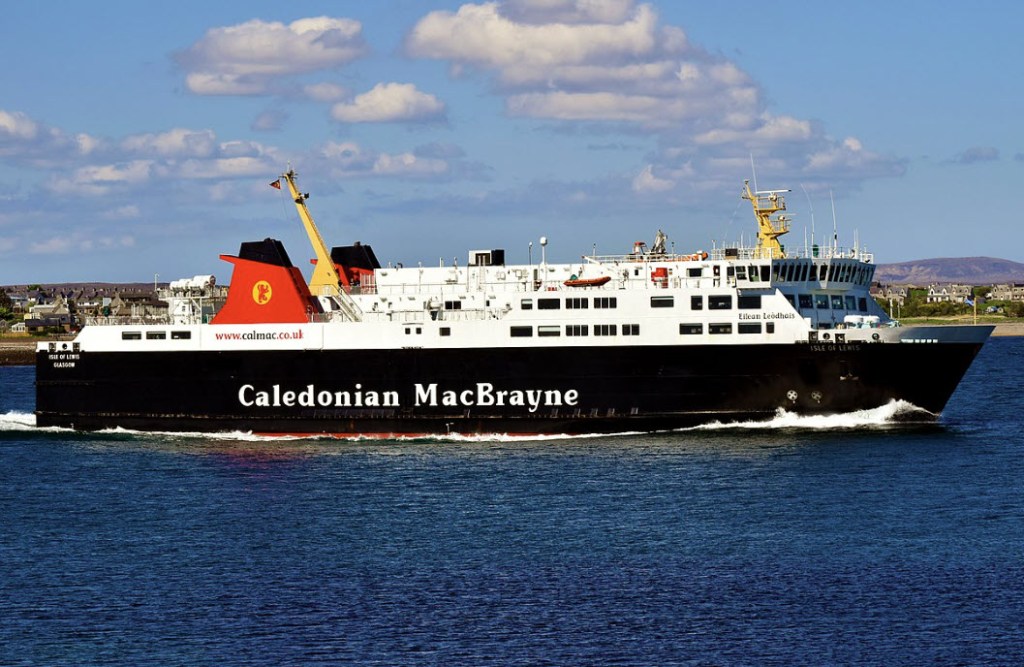
The Caledonian Isles is also suffering from persistent propulsion issues (believed to be propellor pitch control, reminiscent of the Hebridean Isles before her scrapping). She will be re-entering service soon, but with restrictions on the kind of weather she can operate in. Presumably that is a short-term arrangement, and it is unknown when or if she may have to be taken out of service for more repairs. Any long-term unavailability of the Cale Isles will add to the pressure for ships to be shuffled.
The charter of the Alfred has been further extended due to the Isle of Lewis’ issues.
The Isle of Arran is now back on the Craignure-Oban service alongside the Frisa. The Coruisk will take over from the Frisa from March 20th, to allow her to dry-dock. We will then reduce to single-vessel (Isle of Arran) service for a few days between April 7th and 10th, with the Frisa due back from dry-dock on April 10th. It is likely that we will have Isle of Arran + Loch Frisa until Isle of Lewis is repaired in early May, but we have asked for clarification of that. We will be strongly making the case that whatever happens, we must not be left with just one vessel, nor the Coruisk in place of our larger ship.
Fiona Hyslop promises review of commercial ferry fares
Green MSPs Ariane Burgess and Maggie Chapman took advantage of a debate in parliament last week to press the government for a long-overdue review of commercial ferry fares. Commercial vehicles have never been included in RET (Road Equivalent Tariff). Trucks pay more than three times the fare for non-commercial vehicles of a similar size on the Craignure – Oban route. We have regularly pressed on this issue, and argued that all vehicles should pay the same amount pro-rata. It is not just unfair and punitive that commercial vehicles have to pay so much more, but it adds significantly to the cost of life and business on the islands.
We provided the table below to Ariane and Maggie, that shows the scale of the issue, and how inconsistent commercial fares are. These additional fares are passed on to the community in increased food prices, higher build costs, increased carriage prices and suppressed trade.
| 12 metre truck (inc driver) , return | 12 metre motorhome (+1 driver) return | Commercial fares as a % of motorhome | |
| Oban – Castlebay | £841.44 | £660.4 | 127% |
| Oban – Tiree | £674.88 | £550.7 | 122% |
| Kennacraig – Islay | £604.32 | £324.7 | 186% |
| Lochaline – Fishnish | £249.60 | £73 | 341% |
| Oban – Craignure | £426.24 | £132.6 | 322% |
| Ardrossan – Brodick | £397.44 | £153.7 | 259% |
| Ullapool – Stornoway | £642.26 | £491.9 | 130% |
| Wemyss Bay – Rothesay | £246.72 | £113.1 | 217% |
Repeated promises of a commercial fares review have previously been kicked into the long grass, but in one of her final appearances in the chamber, Cabinet Secretary Fiona Hyslop said this:
Yesterday, Ariane Burgess raised the question of freight fares across the network. She highlighted not just the absolute level of freight fares but their level relative to charges for other vehicles. I can confirm that, starting this summer, Transport Scotland will undertake a review that will encompass those issues. Of course, I cannot prejudge the outcome of that review, but I hope that that confirmation is welcome.
Whoever is Transport Minister after May’s elections, we will hold them to this promise, and a fair outcome.
Interim replacement for MV Isle of Mull
CalMac held public drop-in meetings in Craignure and Fionnphort inJanuary regarding re-deployment plans for the MV Isle of Mull (IOM) as new new ferries arrive over the course of this year. Initial plans were for the retirement of the IOM, and her replacement with either the Hebrides, Clansman, Finlaggan or Caledonian Isles. But a further option has now been added to the list – life extension of the Isle of Mull.
All of the potential replacements have compromises. Be it inability to fit passenger access systems (PAS), how well they fit the link-span, extended turnaround times (and therefore inability to hold to current timetables and public transport connections), or reduction in vehicle capacity. Based on information provided by CalMac last year, MIFC’s conclusion was that the Hebrides was the best choice. The Hebrides (or the Clansman) could fit all linkspans, offered increased vehicle capacity and should be able to maintain the same timetable we have now.
The Hebrides and the Clansman look to be discounted however, since neither can over-night on number one berth in Oban. When tied up on the berth that serves Mull, there is no space for a crew gangway. The choice now seems to be between the Caledonian Isles and retaining the Isle of Mull. However, from CalMac’s summary table below, it is clear that the Cale Isles has major drawbacks compared to the IOM (and declining reliability – see below). Not only is PAS fit impossible at one or other end of the route, but CalMac themselves note what we intuitively thought to be the case – the Cale Isles would be more vulnerable to weather cancellations than the Isle of Mull.

A comprehensive ultrasonic steel condition survey has been completed on the IOM’s hull, and a full condition report is due for completion by the end of March. That report will be the basis for deciding whether the ferry that has served Mull for 38 years can have her life extended by another 4 or 5 (without it being too high-risk or expensive). It’s not until 2030 that we may see ships built specifically for our service, at which point the IOM would be 42. That’s the same age as the Isle of Arran is now.
You can view the full presentation boards below.
Ferry and timetable change for Fishnish – Lochaline
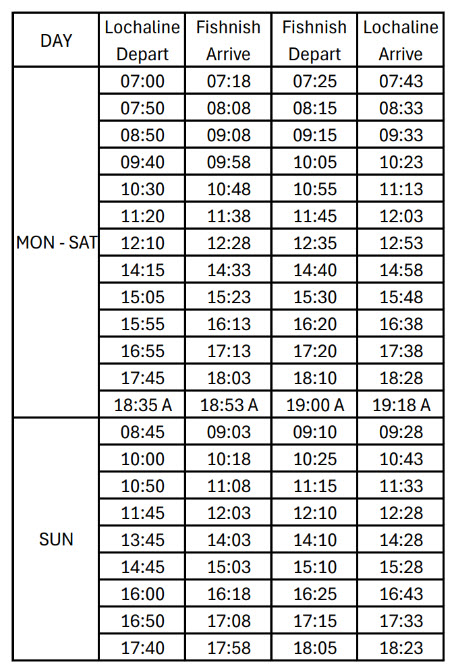
This summer, the Lochinvar will be replaced on the Fishnish-Lochaline route with the much larger Loch Fyne. The extra capacity will be very welcome. However, due to the Loch Fyne being slower and some other technical issues, we are going to have a reduction in return crossings from 14 down to 13 each day. Daily vehicle capacity will still see a net increase of around 50% however, because the Loch Fyne carries 36 cars compared to Lochinvar’s 23.
This change initially included a curtailment of the operating day, bringing forward the last sailing from Lochaline from 18:35 to 18:10. We could see no justification for this, and it would have made the available day on the mainland 25 minutes shorter. We have pushed back against that part of the proposals very strongly, and we are pleased that CalMac have now changed their mind on this. The final sailing of the day from Lochaline will remain at 18:35. The full timetable is below.
CalMac MD Duncan Mackison promises changes to early sailing policy.
Have you ever been frustrated by arriving before departure time, and seeing the ferry has already left the pier? Difficult to believe, but that is deliberate CalMac policy. Masters of all vessels have been instructed for many years that if they are ready to leave, they can depart up to 10 minutes early. It is apparently a fuel-saving measure.
We have complained about this on numerous occasions. In conjunction with the arbitrary requirement for foot passengers to arrive 10 minutes before departure, it results in missed connections, uncarried passengers and huge frustration. It serves no purpose. After a recent incident we wrote to Mr Mackison. He has very quickly responded with a decision to remove the policy:
“I advised that [the policy] related to fuel economy and environmental aims but agreed that it was not in the spirit of community-focussed service delivery. I am pleased to confirm we have now revised our official guidance to Masters so that fuel economy is not used as a basis for a vessel to sail before her scheduled departure time.
I hope you have always found me open to feedback, and open to acknowledging when CalMac could have done things differently. I also hope the above examples show that I listen to that feedback and, where possible, we make positive changes. I want to get to a place where CalMac is getting things right before any community representatives have to raise concerns with us, and I do think we will get there and we’re progressing in the right direction.
This is a very welcome response from Mr Mackison. We are finding him to be responsive, open and fair, and this appears to be a good example of his impact on the company. We’ve asked for a little further clarification however, because his reply does not seem to completely rule out early departure. We have asked him to clarify whether this change means that should a late-arriving vehicle or foot passenger arrive before sailing time and there is space onboard, that they will be carried. We hope to get that clarification soon.
Meeting with Cabinet Secretary for Transport, Fiona Hyslop
Also in January, representatives from Mull and Iona met online with Fiona Hyslop. She heard about the fragility of the service, increasing weather cancellations, and how inappropriate and unreliable our vessels are. She was told first-hand how the education of children on Iona is particularly badly affected.
With only a few months left before Holyrood elections (when Fiona Hyslop will herself be retiring), we made one moderate and achievable request. We asked that the SNP guarantee that should they form the next government, the Deck Space Pilot that has now been running for more than two years will be developed into a fully-fledged ‘Samso System‘.
With acute and continuing lack of capacity in the summer months, island residents should have priority access to vehicle space. No ferry service can claim to be meeting its lifeline need, if island residents cannot come and go when they need to. We are awaiting confirmation from Ms Hyslop that her party will include a promise to implement the Samso System in their manifesto.
We will be writing to the transport spokespeople of every major party, looking for the same commitment.
Weather Cancellations of Monday 26th January
On Sunday 26th January, Monday morning’s Craignure sailings were cancelled due to weather … despite the forecast being for winds of less than 20 knots. The forecast proved to be accurate, but on Monday morning the cancellation was extended to the entire day.
Parents on Iona who carefully watch the forecast every Sunday (so they know if their children will get to school or not the next morning), were taken completely off guard. On seeing the moderate forecast, they were certain the ferry would sail. There was incredulity and disbelief when the cancellation texts came in, with rushed arrangements for volunteers to drive to Oban via Lochaline.
Anyone who has lived on Mull and Iona for any length of time knows it didn’t used to be like this. Cancellation of the Craignure-Oban ferry used to be a rare event. Rarer still was a whole day without service. In the graph below you can see how the winter cancellation rate has grown over the past 20 years.

We raise this issue regularly, but it is a delicate topic. Ships’ Masters have ultimate authority to decide whether to sail or not, as a matter of law. They are responsible for the safety of their ship and the people on it. We would never seek to undermine or publicly criticise individual Masters.
But the company also has a duty to deliver a reliable lifeline service. It seems that the weather threshold at which services are now cancelled is getting lower and lower. When a major ferry remains tied up in conditions that really shouldn’t be a problem, it is difficult to understand why. It is a multi-faceted and often technical issue, but it seems to be influenced by a company culture that has an imbalanced, narrow perception of risk. It sometimes appears as if the possibility that someone might bump into a doorframe when walking around on a moderately rolling deck is enough to trigger a cancellation. Winds of just over 20 knots should not pose a risk for a 3,000 tonne, 85 metre vessel in the Firth of Lorne – yet for whatever reason, those are conditions in which the Isle of Arran felt compelled to stay tied up all day. Meanwhile, the damage done to the islands due to cancelled journeys, missed deliveries, failed appointments and reduced confidence is a pernicious and far more significant risk.
The issue was compounded that day, because as we understand it the Loch Frisa was happy to operate (at least in the morning) – but could not because both berths in Oban were occupied. Whilst the Isle of Arran (and the Lord of the Isles) may have felt unable to complete any crossings, why could one of them not have moved off the berth, idled in shelter and at least allowed the Loch Frisa to operate?
Again we have had a response to this issue from Duncan Mackison that is in part helpful. He agrees with us that the Loch Frisa should have been allowed to operate by moving one of the ‘storm bound’ boats off their berths in Oban. Here’s what he said to us in an email last month:
(On the)… the question of whether MV Loch Frisa could have operated a few sailings in the morning prior to cancelling herself if berth space had been available at Oban. It is my view that she could, so I apologise that we did not take appropriate action to allow the vessel to do so.
Since your email, our Fleet Management Director … has reviewed events leading up to the cancellation of services and berthing at Oban. Following that, we are going to:
- Review the way we manage vessels occupying berths when not in service, with a view to ensuring vessels, where possible, move on and off berth or stay at sea to avoid blocking other vessels from operating passenger services
- Standardise the way Masters provide information to IOCC when cancelling services due to weather, so it is consistent across the whole fleet and allows CalMac to consistently manage the impact network-wide
So on the issue of freeing the berth, we have a positive response.
But the wider issue of increasing weather fragility is unlikely to be resolved soon, but we will keep raising it whenever incidents like this arise. Increasing weather-related cancellations are often explained away to MSPs, officials and others as the consequence of climate change. We have made extensive study of local Met Office wind records, and can find no evidence that high winds are becoming more prevalent. Sea temperatures may be rising and rainfall patterns changing, but there is no evidence that our winters are getting windier. If anything, the opposite is the case.
Meeting with Mairi Gougeon
Representatives from MIFC and Argyll islands who were initially excluded from the ferry compensation fund (formally the Island Business Resilience Fund) met with Mairi Gougeon in February (Cab Sec for Rural Affairs, Land Reform and the Islands).
The meeting was a follow-up to our successful campaign to open the IBRF to Mull, Iona, Coll, Tiree, Islay and Jura. Whilst the change was very welcome, we made it clear that the whole issue had been managed appallingly. For a program overseen by the Islands Team who are also responsible for implementation of the Islands Act and formation of the Islands Plan, it was astonishing that such a divisive scheme had been rolled out without any consultation, nor any attempt at an Island Communities Impact Assessment, as is required by the Islands Act.

It is an example of how the Islands Act is so often only given lip-service, or completely ignored. We’re pleased however that businesses on Mull and Iona were finally able to benefit from the IBRF, and get some support to compensate for several years of such poor service from our ferry system.
Improvements for foot passengers in Oban?
We have been raising the need for better facilities in Oban for foot passengers using the Loch Frisa. We have suggested a bus shelter type canopy be added to the walkway to the linkspan, but currently that seems undeliverable. We’ve also suggested that the Frisa be modified so that the Passenger Access System can be used, and that is being investigated. Meantime, improvements to signage and passenger information is being organised, in an effort to encourage people to stay in the terminal building as long as possible, and not feel that they have to stand for long periods outside, often in the rain.
If you have suggestions or experiences to share that we can pass on to CalMac regarding this, let us know.
Consultation on our future new ferries – ‘Community Needs Assessments’
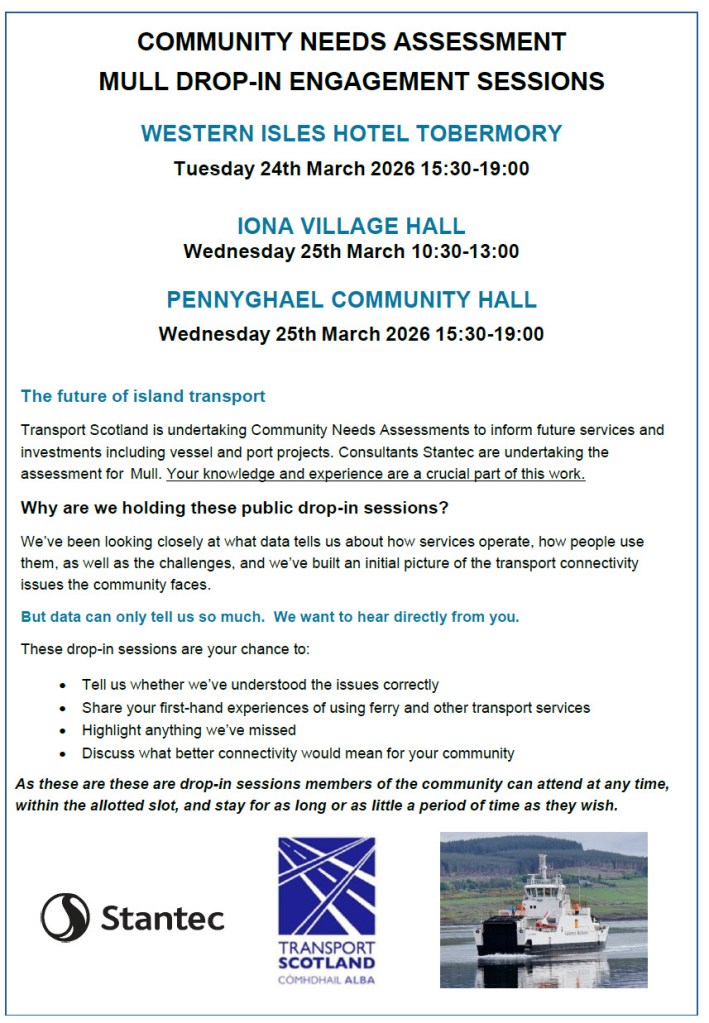
Consultants working for Transport Scotland are holding a series of drop-in meetings later this month. They are intended to gather community views on what our future ferry service should look like. It will feed in to both the new ferries planned for Mull, the Craignure pier renewal and other potential improvements. This is a big topic, and these are important meetings to make your voice heard. Its your opportunity to imagine what our ferry service could be like in the future. Maybe even no ferry at all, and a fixed link instead? (An idea that is included in the new version of the Islands Plan).
We will have more news on longer-term issues shortly, following on from CMAL’s meetings back in December. This post is long enough for now!
On Friday 30th January the Isle of Arran DID run a full day’s service, despite the wind forecast being worse than it had been the previous Monday. Source of wind forecast: XC Weather. But I expect Calmac use a different service.