
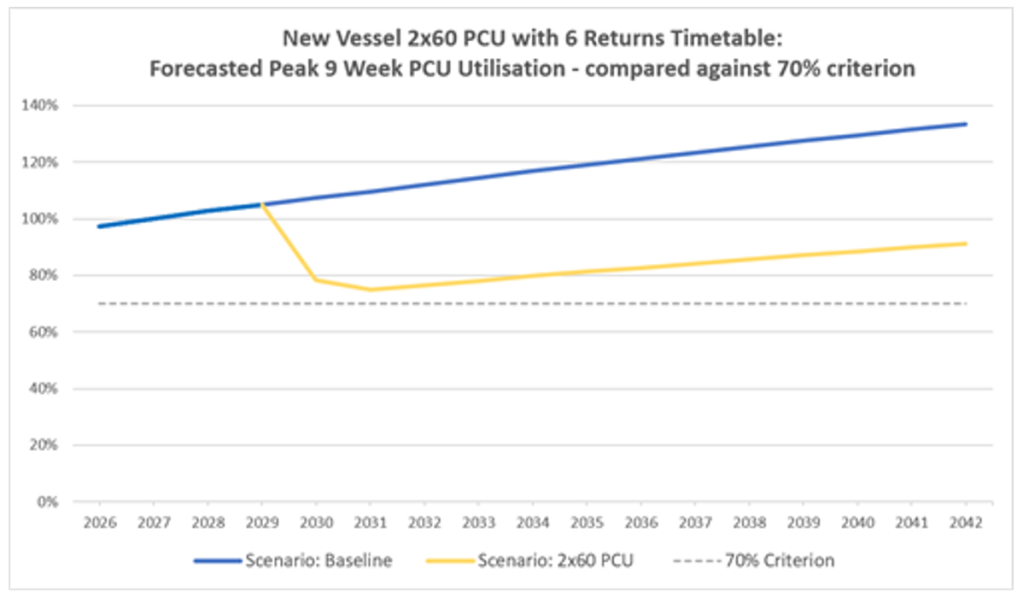
If you attended CMAL’s public drop-in events in December of last year, you might remember seeing the graph below. It summarizes how well Mull’s planned new ferries will meet vehicle demand over the coming years. In this graph, Transport Scotland count the total number of vehicles carried in the peak 9 weeks of summer, and compare it with the total vehicle deck space available. 100% utilisation would mean that every car space on every sailing is used. Due to variable vehicle sizes however, anything over 80% utilisation generally means ‘full’. As you can see from the blue line, without new ferries our service is predicted to hit 100% utilisation next year, and worsening – that means that not only are the ferries full, but that increasing numbers of travelers will be turned away.
For ‘utilisation’, read congestion. The higher the utilisation, the worse the congestion. The more difficult it will be to get your vehicle on the sailing of your choice, and the more difficult it will be to travel to and from Mull and Iona.
Transport Scotland’s Vessel Replacement and Deployment Plan sets 70% utilisation as the maximum target. It says that at 70%, “Full sailings are a regular occurrence, and an increasingly significant number of customers chose not to travel as alternative sailing times are not suitable.”. Already Craignure – Oban is the most congested route in the entire network, with utilisation over the 70% target. That should give you an idea of what 70% utilisation feels like in practice – just think back to every summer in the past few years. Below you can see how CalMac’s major routes’ utilisation levels (aka congestion) compare (based on 2019 carrying figures and the vessels used at the time)
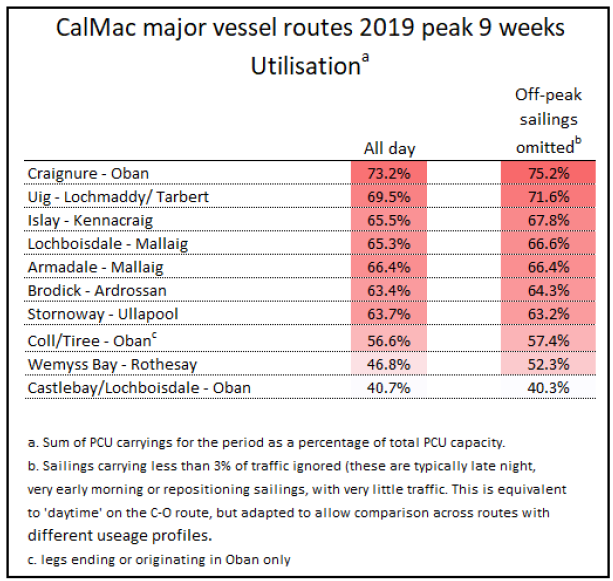
When sizing new vessels for a route, Transport Scotland’s objective is to keep the utilisation figure below 70% for at least the first 10 years of the new ship’s operation. We can see how that target has played out in recent new vessel procurement. By our calculations after introducing two new vessels to Islay, utilisation is expected to be around 44%. The Glen Sannox and Glen Rosa will take Arran’s utilisation to around 38%, and the two new vessels being introduced on services out of Uig will reduce utilisation there to just under 30%.
Transport Scotland’s current plan for the Craignure – Oban service is to build 2 new vessels, each of which is capable of carrying 60 cars (and operating to broadly the same timetable as now). That will be a total uplift in capacity of a little over 20%, compared to what we have now.
You might be surprised therefore to see in Transport Scotland’s graph above, that after introducing these two new vessels, Craignure-Oban utilisation will be no better than it is now, and after just three years it will be over 80%. We will not even come close to the 70% target for one year, let alone stay under it for 10. We will have utilisation levels that are vastly higher than those soon to be enjoyed by Islay, Arran and Little Minch services when their new vessels are in service.
We have challenged CalMac, CMAL and Transport Scotland on this, and the answers have not been reassuring. Despite being one of the key guiding metrics for all recent ferry procurement, the 70% figure appears to be at best sidelined, and at worst ignored for Mull & Iona.
Our survey of 2021 confirmed that islander consensus was in favour of smaller ferries operating a high-frequency service. So whilst 60 cars unloading from each vessel is a good match for our single-track road network, we will need more summer sailings in order to meet demand. There are a few ways that more sailings can be delivered –
Firstly, operate the ferries for longer each day. That has the advantage of offering sailings at times that are convenient for long-distance trips or extended days away, and we should certainly have those options. But our analysis of CalMac’s carrying figures shows that 80% of traffic demand is between the hours of 08:30 and 18:30. So adding sailings early and late in the day would be advantageous, but they wouldn’t be of little use to people at the times most journeys are actually made. Half-empty sailings running late into the night would move the utilisation figure down – but if the daytime ferries remain as full as ever, real congestion will be just as bad as now.
Secondly, the ferries could operate faster, taking less time to cross and turn around. There is definitely room for improvement on this. The MV Isle of Mull used to operate six return sailings per day when she ran the service on her own. She could make the journey and turnaround in 60 minutes, so was able to complete more sailings each day. When the slower Coruisk was introduced, journey time went up to 50 minutes and turnaround to 20. The Frisa is slower still. With two vessels operating in tandem, sailings have to operate at the speed of the slowest vessel, and now 70 – 80 minutes is the ‘norm’. So embedded is this slow pace, that CalMac do not plan to operate the new vessels within the 60 minutes achieved by the MV Isle of Mull. In other countries, routes operating ships the size of the Isle of Mull (and bigger) routinely turn around in 10 minutes, thanks to efficient ferry and terminal design. So a return to an hourly timetable operated by two equally-matched ferries would perform better than Transport Scotland’s projection. But there is a limit to how much faster ferries can run.
The third option is to put more ferries on the route. Together with returning to an hourly timetable, this is what we believe is necessary. An hourly timetable will allow more sailings to operate through the peak daytime hours, but unless there is a third ferry – for at least part of the day, in part of the year – there will be no improvement to the chronic congestion on our main ferry service.
This is the conclusion of a major piece of work that MIFC have undertaken. Rather than accepting Transport Scotland’s ‘two slow ferries’ proposal, we have put together our own recommendations. The document below has been submitted to Transport Scotland and the team now working on the New Mull Vessels project. Following the advice of experienced and successful naval architects, this is the first and major part of our Service Requirements.
You can read the full plan below, and we welcome all and any comment on it. The key aspects of what we propose however, are as follows:
- Two vessels dedicated to the Craignure – Oban service, each carrying 60 cars and around 500 passengers
- A third vessel shared with Colonsay. This runs a daily service to Colonsay, and supports the Craignure service at peak times (morning and late afternoon). This adds capacity for Mull at the times we need it; provides a much improved service for Colonsay; and frees up both the Finlaggan and Clansman who currently operate to Colonsay.
- An hourly operating cadence, with clockface departures. Crossing to be 45 minutes, turnaround 15.
If delivered, the “2.5 ferries” model would significantly outperform the current TS proposal. Critically, it would actually meet Transport Scotland’s own 70% utilisation target, and it could remain under it for up to 20 years.
Please read the full proposal and let us know what you think. We will be following it with a subsequent part looking at onboard services, weather reliability and other aspects.