
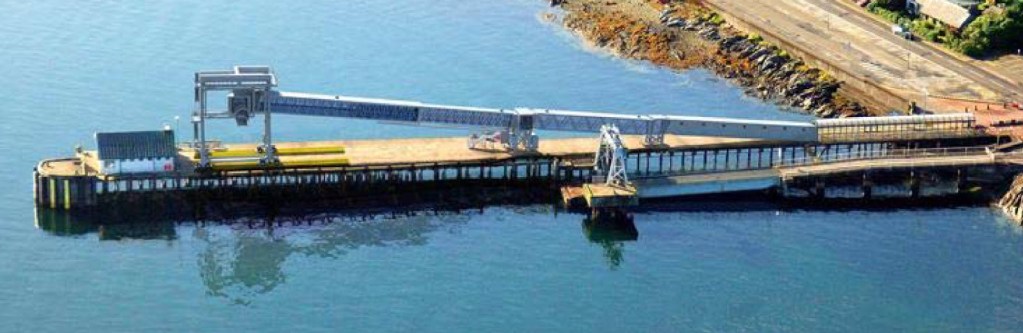
CMAL have this week confirmed that they are going to scrap the Passenger Access System (PAS) on Craignure pier, and will be leaving it to others to come up with an alternative. Some kind of ‘interim’ solution is most likely, similar in style to a traditional gangway hoisted by the ship. Until then, foot passengers will have to continue to transit via the car deck on all sailings, leading to regular delays and increased risk of an accident.
Whilst the Craignure PAS is unsightly and can only operate to the MV Isle of Mull, until a couple of months ago it conformed to necessary regulations, and was safe and fully functional. However earlier this year, a minor winch that raises and lowers the final ‘flap’ that connects with the ferry was incorrectly wired and ran in the opposite direction to that intended. It was damaged and needs repair or replacement.
The work required is minor, and would return the PAS to its original ‘as-built’ condition. Some other precautionary work would also be adviseable (such as replacement of the main lifting cables). However, CMAL have taken the view that the work actually qualifies as ‘refurbishment’ rather than repair. They say that as ‘refurbishment’, they will be obliged to bring the PAS up to current safety standards at the same time (rather than those that applied at the time it was built in 2011). That work is so extensive and costly that they deem it uneconomic, and therefore the only option is to scrap the PAS.
We have asked CMAL to detail the regulations that are forcing their hand in this way, and they have given us two main references. These regulations are clear that if the PAS was being modified or refurbished (ie adding new functionality, new control systems, changed capacities, being re-sold etc), then yes, it would be expected to be brought up to compliance with current safety standards. But what is described by CMAL is very clearly repair to its original ‘as-built’ condition, and therefore new standards are not applicable. We have consulted with several qualified and experienced engineers, and all have agreed with us. If CMAL simply fixed the damaged winch and undertook any other repairs necessary, the PAS would be just as safe and legally compliant as it was before the breakdown. CMAL’s assertion that they have no choice within the law but to scrap the PAS is a provable falsehood.
It seems that CMAL resent having responsibility for a piece of kit that was only ever intended to be temporary. When the prior PAS was condemned, previous CMAL management offered CalMac a cheap and quick solution. Using left-over parts from CMAL ports, they could put a temporary PAS in place that would see us through until the Council built a new one. But the Council then sat on their hands and were content for CMAL’s PAS to remain in use for what has turned out to be 15 years.
It is highly likely that the delays we are now experiencing as a result of extended turnaround times will have to be integrated into our timetable (at least partially). This threatens essential public transport connections and key ferry timings. In the extreme, it may lead to a reduction in the number of sailings operated at peak times.
Most ironically however, a decision that CMAL say is driven by safety is actually going to result in increased risk to both passengers and staff. Already there has been one hospitalisation as a result of foot passengers having to transit via the steep internal stairs and the car deck. Anecdotally, there have been other more minor incidents too. If a traditional gangway eventually replaces the PAS, it will be inherently less safe – it will be steeper; have steps or cleats; and it will be open to the weather. For many passengers (particularly the elderly or those with mobility issues) it will be unuseable. In some states of tide it could be too steep for anyone.
One consultant we have spoken with has also queried whether CMAL’s plans contravene equalities and accessibility law. It is illegal to downgrade or remove features put in place to enable equal access for those with disabilities. In this instance, the deliberate mis-interpretation of one piece of safety law may be directly leading to the breaking of another.
It seems that CMAL’s eagerness to remove equipment from their risk register is more important than true passenger safety and service in-the-round. This is a cynical decision made for CMAL’s benefit, not users. It is also far more costly. Just removing the old PAS is very likely to be more expensive than repairing it. Replacement with something new (and with less utility) will cost many times more. CMAL’s ability to spend our public money is certainly impressive.
We have little confidence that if left to Argyll and Bute Council, a PAS or even a gangway will materialise. The planned works to replace Craignure Pier are years late and ballooning in cost. A tender invitation for the design and management of the new build was issued nearly a year ago, and still no contractor has been appointed. With that kind of performance, it is difficult to imagine them delivering a new PAS system or even a gangway anytime soon. Last year the Council went through the process of tendering for an entirely new PAS, but the project was dropped – presumably because they hoped the CMAL system would last a few more years.
Below is the full email thread of our conversations with CMAL over the past two months. If you are interested in getting into the detail of this, its all there for you to read. If you have professional expertise close to the subject, we would be pleased to hear what you think of it.
Their reasoning does not make any sense as the dictionary definition of refurbishment is the same as repair.
They are different so far as British Standards are concerned though.