
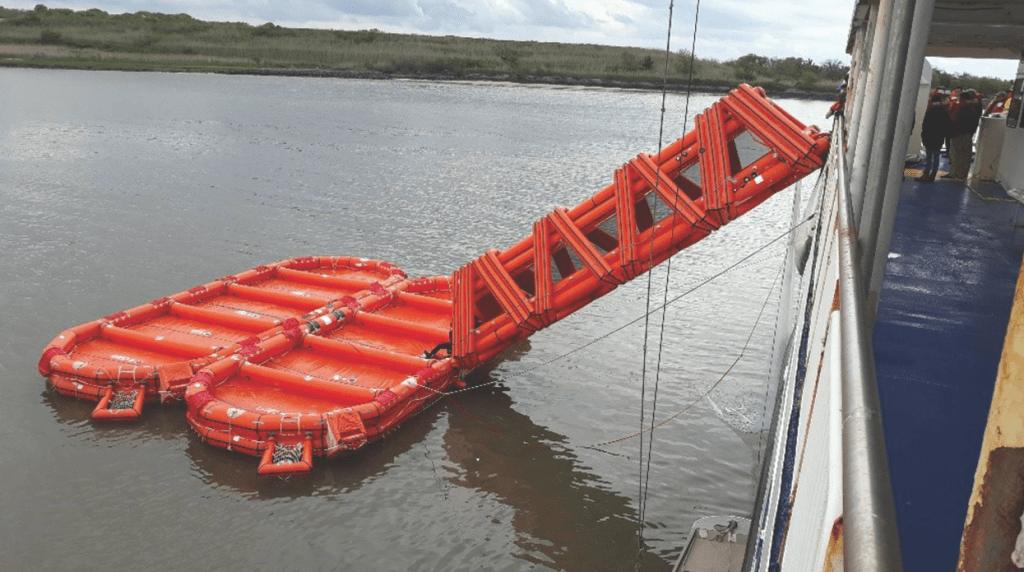
We have recently learned that due to delays with the dry-docking of the Finlaggan and Hebrides, the work to renew the Isle of Mull’s emergency evacuation slides has been pushed back. The IOM is not now expected back on service to Craignure with full passenger certification until June 25th June 29th (Originally she was due to return on June 15th). The Coruisk will continue to cover for her until then, whilst in the meantime she operates services to Lochboisdale with a passenger capacity of just 45. Further delays to her return would not be surprising.
We have worked hard to come up with mitigations for the extreme lack of capacity on the Craignure-Oban service, but with little success. Despite the Loch Frisa having two sets of crew that in theory could allow the ship to operate much longer each day, the practicalities of enabling that have proven too much –
- In order to keep a berth vacant in Oban to qllow the Frisa to run sailings before and after the limit of Coruisk’s working day, the Coruisk would need to berth overnight on the south side of Craignure pier every night. However, Argyll and Bute Council have booked out the south berth for the use of the two small cruise ships Lord of the Highlands and Lord of the Glens on several nights each week. This follows what the Council say is a long-standing policy that bookings are taken on a first-come-first-served basis, irrespective of who that booking comes from. So in effect, cruise ships (that do not land passengers whilst berthed over-night and therefore their over-night use of the pier is of very little economic benefit to the island) are taking precedence ahead of ferries at the island’s ferry pier.
This is a completely peverse policy to operate at a public pier. Particularly one that delivers a life-line ferry service. We have made the case for a change with Council officials, and whilst they have been open to suggestions that might fix the immediate problem, there is no indication that the policy will change.
This is despite evidence demonstrating that commercial vessels pre-booked at the Council’s North Pier in Oban routinely have their bookings cancelled in order to enable pleasure craft to gain access. So it seems that cruise ships and yachts take precedence over ferries and work boats at more than one Council pier, and the ‘first come first served’ policy is not applied uniformly.
This is something we will be persuing with elected members for a change. If you agree with us that ferries should always get precedence at our public ferry pier, please do write to one of your local Councillors. - The difficulties of completely re-designing the timetable at short notice are significant. Bus times cannot be changed, so key ferry connections cannot move much. Berth clashes in Oban limit the changes that are possible, and crew changeovers also have to be accommodated. All of which combined make signifcant but immediate timetable changes very difficult.
- The passage time of both the Coruisk and Frisa is much longer than the Isle of Mull, making it more difficult for them to maintain public transport links and run additional sailings. Most people will remember the days when the Isle of Mull was timetabled with a 40 minute crossing time, and departures were reliably on the hour. With boats that take 55 – 60 minutes to cross and turnaround times now routinely 20 minutes rather than the previous 15, timetable flexibility and frequency is severely compromised.
The only very minor change we have secured is the delay of the last Friday departure from Oban to 20:45, in order to offer a little more time on the mainland. We have asked for extra capacity to be added to Fishnish-Lochaline, but there are no spare vessels available. The possibility of extending operating hours by adding crew is still being investigated.
Please use Fishnish-Lochaline if you can
If your journey is being made by car and travelling via Lochaline is a workable alternative to Oban, we’d encourage you to please use that option. It’s also helpful if accommodation owners can continue to encourage visiors to use this route.
For those relying on public transport, Craignure-Oban is their only viable option. With such low foot passenger capacity however, some sailings are maxxing-out on passenger tickets, potentially leaving bus and train passengers stranded. So regardless of whether you are travelling on foot or in a car, buy your tickets before travel.
Deck space priority pilot is still operating
Remember that if you are a resident on Mull and Iona, you are welcome to make use of the deck space priority pilot scheme. It is ony operating on Loch Frisa sailings however (one of CalMac’s stipulations is that during disruption the pilot may be suspended – so as a compromise it it only working on the Frisa until the IOM returns).
Exactly 72 hours before sailing time, the final 10% (about 3 car spaces on the Frisa) is released for sale. So if you have a short-notice need to travel, this could help you. Currently, availability on daytime Craignure-Oban sailings is very thin on the ground, right though to the middle of June. Saturdays are particularly bad, with the over-flow traffic going via Lochaline routinely resulting in long waits there.
Fiona Hyslop announces compensation fund for island communities
The cabinet secretary for Transport has announced a £4.5 million compensation fund for island communities affected by ferry disruption. It is not yet known what the eligibility criteria will be, or how applications for assistance will be handled. We have written to Mrs Hyslop seeking clarification on that, and highlighting the economic and social damage being done by the withdrawal of the Isle of Mull from our route.

What will come after the MV Isle of Mull?
With a further five new vessels set to join the CalMac fleet in the next 12 months or so (joining the Glen Sannox now operating between Troon and Brodick), the MV Isle of Mull is slated for retirement possibly as early as 2026. At that stage the Craignure-Oban service could be served by either the MV Caledonian Isles, MV Finlaggan, MV Hebrides or MV Clansman. Whichever vessel is chosen, it will continue to operate beside the Loch Frisa on an interim basis until completely new vessels are built to replace both.
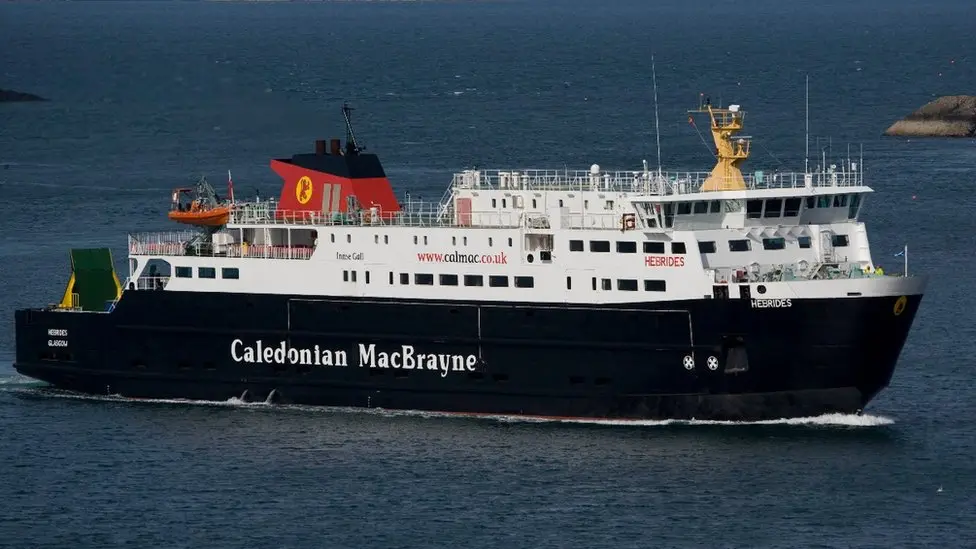
All of these vessels come with compromises in terms of their ability to fit linkspans, passenger access system (PAS) compatibility, crossing time, vehicle capacity and turnaround times. They also have to be able to deal with berthing load limits being imposed by Argyll and Bute Council at Craignure Pier. After reassessing the pier structure, the Council have determined that any vessels heavier than the MV Isle of Mull may not contact the fendering at more than 0.2 metres per second – ie they have to do it very slowly in order to avoid damage. That will be a challenge when the wind is up, so whichever vessel replaces the IOM, it is likely to maintain a more reliable service if it is controllable and manouvrable in poor weather. That is one of the criteria that has led us to request that the MV Hebrides replaces the MV Isle of Mull, rather than the Caledonian Isles or the Finlaggan. (Clansman is a close second). The Hebrides will be relieved from Uig triangle services when the third and fourth Turkish vessels arrive.
In comparison, the Finlaggan offers no capacity increase without much longer turnaround times needed for loading her mezzanine decks. Longer turnaournd leads to fewer sailings being able to be run each day, so total daily capacity would actually decrease as a result of loading more vehicles on each sailing. In addition, she does not fit the Craignure PAS and lacks the power needed to be gentle to Craignure pier in windy weather.
The Caledonian Isles also offers greater capacity than the Isle of Mull. But again, this is only if the mezzanine decks are used and therefore turaround time lengthens. Daily capacity would therefore be reduced. Public transport connections would also be difficult to maintain. On top of this, it is likely that foot passengers would have to disembark via the car deck in Oban, further lengthening turnaround times.
Below is a PDF that we requested from CalMac, summarising the key attributes of each vessel. We have highlighted the negative aspects of each in red. From this you can see that the Hebrides offers increased capacity, and the ability to maintain the same timetable as the Isle of Mull. Issues with PAS compatibility remain however, which will need to be addressed. Like the Clansman, she is known to have good ‘station-keeping’ (ie more power and manouvrability in slow-speed manouvres against the wind), so should be more able to keep to the 0.2 m/s berthing limit in the winter.
It’s likely therefore that this is the MV Isle of Mull’s penultimate year of service – perhaps even the last one. She has a pretty good reliability record, relative to others in the fleet. But at 37 years of age she is well past retirement time. With half a dozen new major vessels arriving this year and next, at least another three (in addition to the Hebridean Isles) need to retire. MV Isle of Mull, MV Isle of Arran and IMV sle of Lewis are the most likely retirees.
Loch Frisa has a reduced vehicle ramp weight limit
We have recently learned that the vehicle ramps on the Loch Frisa had their weight limit down-graded to 27 tonnes last August. This particularly impacts one type of commercial vehicle – eight-wheeled tipper trucks used to deliver stone aggregate and so on. A fully laden truck like this weighs around 34 tonnes.
The most notable casualty of this reduction is that tarmac trucks coming to Mull to resurface our roads cannot carry full loads. They have to come across with only 14t of tarmac onboard, rather than around 20. This obviously makes the re-surfacing work more expensive, takes longer to complete and more ferry space is needed.
We have written to CalMac seeking clarification on exactly why this reduction was decided upon. The ramps on the Frisa are after-all the youngest in the entire CalMac fleet, having been designed and built in 2022. When new there were no restrictions, and any road-legal truck could be carried. It seems that extensive ramp damage caused to the Loch Shira prompted CalMac to reassess ramp limits. But it remains unclear why such new ramps should have their capacity reduced, and who is liable for it. Is it a design error? A manufacturing error? A specification error? We are trying to find out.
Meantime we have also asked why affected vehicles are not being offered a discount on their ticket price.
Craignure Pier renewal plans moving forward
Argyll and Bute Council recently announced revised cost estimates for the replacement of Craignure Pier. They now expect it to cost £96 million, nearly double the 2020 estimate of £50 million. This is put down to ‘inflationary pressures’.
The Council’s Harbour Board have approved the spending of £3m over the next 18 months or so, to progress the design and business case ahead of tendering. Construction is currently planned to start in 2027.
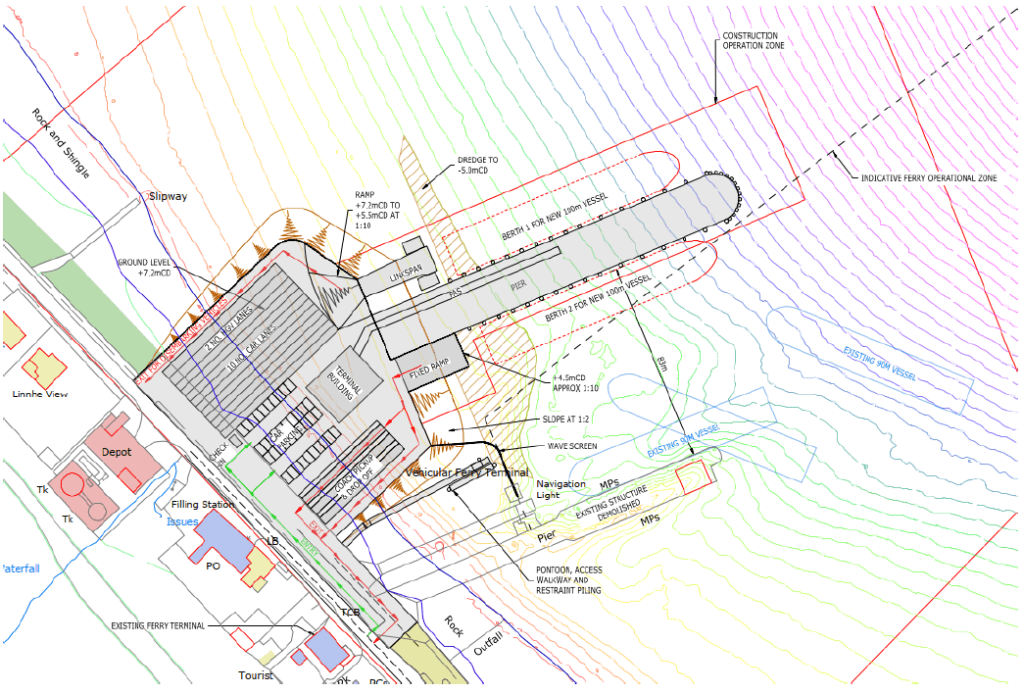
Whilst renewal of Craignure Pier is definitely needed (due as much to the increasing size of CalMac vessels as it is to the age of the structure), we have concerns about the pier design. It appears to follow the same format as the recent Brodick pier, which has been criticised on multiple fronts. There are three key features that are missing –
- There is no second link-span. With reliance on just one linkspan, there is lack of the flexibility and redundancy required for our high-frequency, high-traffic service. A second linkspan would give much greater flexibility in timetabling (allowing two ferries to be berthing or loading simultaneously or closely behind one-another), and in the event of breakdown, greater reliability.
- There is only space for 2 (very large) vessels to berth, when space for three smaller ones could be what is needed. CalMac’s own assessment is that the service may be best satisfied in the future by three medium-sized vessels, and we agree. Three ferries would give the greatest flexibility, frequency, reliability , capacity and length of operating day.
But not all ferries would operate together all day long, and so two lay-up berths would be needed, leaving a linkspan available in both Craignure and Oban for one vessel to operate to. With no space in Oban for an additional berth, the best solution is to provide space for two inactive boats in Craignure – but that does not appear on the Council’s plans. - The design does not appear to be optimised for fast turnaround. A key requirement is a return to turnarounds of no more than 15 minutes, as the Isle of Mull used to maintain. 10 minute turnarounds for ships of similar size is common-place in Norway. It is only with fast turnaround that we will be able to return to a clock-face timetable. In order to do that, multiple lanes of vehicles would need to embark / disembark at the same time, rather than just one. Passenger access systems may have to be re-considered (potentially yielding cost-savings that would help to fund the second linkspan), and automatic mooring and/or lock-on linkspans may be needed to reduce or eliminate the use of time-consuming ropes.
We are making efforts to get a dialogue with Transport Scotland regarding the pier plans, since these are strategic questions that fall in their remit. The Council will build whatever the operator (CalMac) and Transport Scotland (who set policy) require of them. We need to ensure that this once-in-a-generation development that will shape transport to and from Mull for the next 80 years is done with the community’s needs at its centre. There will certainly be more to follow on this, and we very much encourage your comments and thoughts.
That’s enough for now! It’s been a while since we have posted, so there has been a lot to cover.
(that do not land passengers and are of very little economic benefit to the island)
Referring to the Lord of the Glens/ Highlands like that is a wee bit harsh. When berthed at Craignure the passengers are bussed to various destinations around the island. There will be approximately 30 visits throughout the summer. To dismiss this as being of very little economic benefit to the island is, quite frankly, out of order.
Hi Alasdair
You are right, they do land during the daytime and passengers are bussed to Iona. I should not have phrased it the way I did, and I’ll correct it.
However, the berthing clash with the ferry only occurs over-night, when it could be used by the Coruisk. At night the cruise passengers do not come ashore, they remain on board to dine. So it is correct to say that the cruise boats are preventing use of the pier overnight, and no passengers are landed at that time that might in some way balance the economic / operational / social impacts of not allowing the ferry to operate.
Cruise shipsa are welcome, and temporary berthing during the day when they do not interfere with ferry operations is no problem. The point is that a public ferry pier should be prioritised for use by public ferries, and it is not.
Do you think the return date for Isle of Mull is a reliable one? I’m worried about train connections on 30th June if she doesn’t come back. I have hospital appointments in Glasgow.
Difficult to remember the last time a CalMac ship returned from having work done on time….
Whatever happens, CalMac should ensure you make your hospital appointment using the Urgent Medical Appointment Protocol. Wait until a few days before the appointment, and if there is a delay to the return of the IOM contact CalMac on the phone and tell them you need to ensure you make a hospital appointment using the medical appointment protocol. If you have any difficulty at all, email me at joe@islandbakery.scot and I will help.