
The ferry shuffle continues.
CalMac is facing another very difficult winter, as it tries to juggle various problems and the fleet dry-docking schedule. MV Caledonian Isles remains out of service, having developed gearbox problems immediately after returning from around nine months of extensive hull repair work. Initially expected back in service in August, the latest estimate is that she will finally return on November 20th.
Meantime MV Hebridean Isles is serving out her final weeks of service, after 39 years plying CalMac routes. Her certification expires on November 21st, and the company have decided that she is no longer economical to keep running. Only in 2023, millions of pounds was spent fixing an intractable issue with its variable-pitch propeller system, at a cost and effort that was only justified by CalMac’s desperation not to lose a vessel, even one so close to retirement.

As they lose the Heb Isles, CalMac should soon gain the new Glen Sannox. But as of today, there is still no handover date announced. It’s highly unlikely that the Sannox will be carrying passengers until at least January. So despite the new vessel, CalMac’s major vessel fleet will remain under strength.

The first of the four Turkish new-builds had been due to arrive in October. This has now been delayed by around four months, so the MV Isle of Islay will not be in service until the summer of 2025. Through 2025 the second, third and fourth Turkish ships should arrive, as well as the Glen Rosa, currently being fitted out at Fergusons.
With one ferry already on hire (the catamaran Alfred), CalMac have been looking at others that could be available. The Ben-my-Chree owned by the Isle of Man Steam Packet Co carried out berthing trials in Troon and Brodick this week, but they were unsuccessful.
What’s the impact on Mull and Iona?
The Craignure – Oban service will be served all winter-long by the Loch Frisa as is now usual. CalMac and Transport Scotland agree that Loch Frisa cannot provide an adequate service on her own (due to both low capacity and slow speed). Due to the vessel shortage however, we are set to have single vessel service for around 60% of this winter period. See the calendar below for a summary of when each timetable applies (this incorporates the latest announcement that the LOTI will be leaving early, and Frisa-only service will re-commence this week on Monday).
Should there be any breakdowns or overhaul delays elsewhere in the network, it is highly likely that whichever secondary vessel is working alongside the Loch Frisa will be called upon. As always, keep a close eye on CalMac’s service status page.
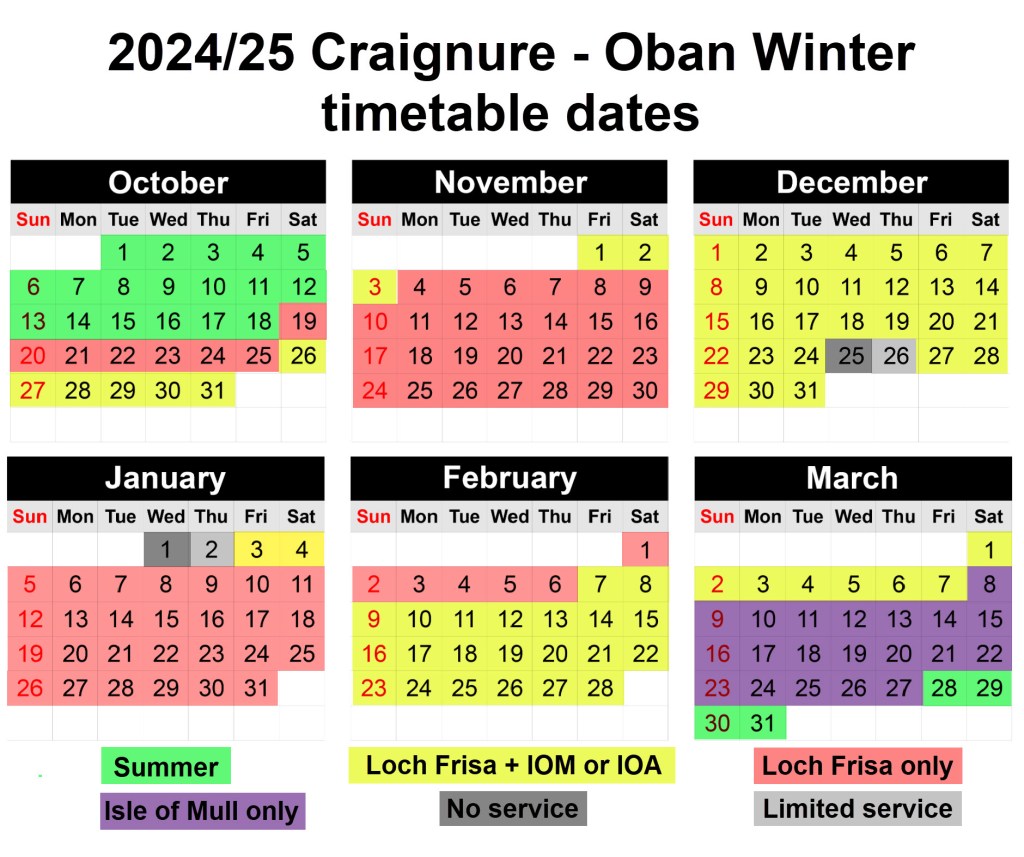
[scroll to the bottom to download the timetable calendar and timetables as a PDF]
Summer timetables 2025
Now is our opportunity to make any change requests for 2025 summer timetables. Last year we tried to get more Sunday sailings by the Loch Frisa, which would have been possible if the IOM of Clansman had been able to move off the berths in Oban briefly on Sunday morning. That turned out not to be possible, but t is something we could pursue again.
If you have any suggestions for any of Mull & Iona’s services for next summer, please email them to mullandionaferrycommittee@gmail.com . For reference, scroll to the bottom of the page to download PDFs of this summer’s timetables. WE NEED TO RECIEVE ANY SUGGESTIONS NO LATER THAN WEDNESDAY NOVEMBER 6TH.
Passenger shelter in Oban
Earlier this year we asked CalMac and CMAL to look at the possibility of adding a shelter beside the car marshalling lanes in Oban, for people waiting to board the Loch Frisa via the car deck. They have concluded that there is not space. A disappointing outcome.
Whilst investigating this, we became aware that some passengers were taking the instructions printed on their foot passenger tickets literally. All tickets, even those for foot passengers, are printed with the 30 minute check-in instructions that apply to vehicles. If you are a foot passenger, you do not need to present yourself 30 minutes before sailing. The check-in time for foot passengers is just TEN MINUTES. CalMac are now also making an announcement in the terminal building when the Frisa is ready to board. So you can stay in the shelter of the terminal building and await that announcement. But be sure to be at the linkspan no less than 10 minutes before boarding.
E-booking issues continue
Problems with CalMac’s new ticketing system introduced in 2023 persist (like those incorrect book-in instructions on foot passenger tickets). Many of those problems are internal – some processes remain more time-consuming and difficult for CalMac staff. You may have noticed for example that on small vessel routes, there are now staff at each end selling tickets before you board. This is due to technical difficulties on-board.
For passengers however, there are still many problems with the website. From big things like still being unable to make livestock or commercial bookings online, to small things like being unable to move a ticket from a sailing that is sold out. We are arranging a meeting with CalMac management to address the outstanding issues. If you have a particular bug-bear or improvement suggestion, please let us know about it by emailing mailto:mullandionaferrycommittee@gmail.com . Also at the bottom of the page you will find CalMac’s latest news release regarding changes to E-booking.
MV Isle of Mull earmarked for disposal
The MV Isle of Mull and MV Isle of Lewis have been identified as the next potential candidates for the scrap yard after the Hebridean Isles. The IOM is now 37, and the Isle of Lewis 29 years old. The IOM is a candidate on age grounds alone, whilst the slightly more youthful IOL is particularly inflexible, being capable of operating to only four ports (Ullapool, Stornoway, Oban and Castlebay). Now operating between Oban and Castlebay primarily because there are few other options, she is hugely over-sized for one of CalMac’s lowest-volume routes.

If the IOM is disposed of, the working assumption is that one of either the Finlaggan, Caledonian Isles or Hebrides would replace her (until new builds arrive in some years). Whilst all of these vessels could in theory provide increased vehicle capacity in summer months, they may be compromised by Craignure pier. All of these ships are significantly heavier than the IOM. Engineers appointed by Argyll and Bute Council (owners of the pier) have concluded that whilst they could operate to the pier, they can only berth at very slow speeds and with caution. The pier structure is generally sound, but it was just not designed for CalMac vessels that have become progressively longer, taller and heavier over the years.
The upshot of this is that if one of those vessels is cascaded to Mull, it may not be able to operate to the current timetable. Longer turnarounds may be needed, in order to allow for more frequent use of the round-head at the end of the pier. Winter reliability may well further deteriorate also.
At a recent meeting with Council officials and elected members, it was made clear that the Council will not consider any remedial works that might alleviate this potential problem. With a complete new-build being planned (perhaps for completion in around 5 or 6 years), they insist that strengthening of the timber fendering or any other engineering solution will not be considered.

We are arranging for meetings with CalMac’s Marine department, so that we can gain better understanding of the implications, should one of those larger vessels replace the Isle of Mull. It is possible that next summer could be the MV Isle of Mull’s last. Should that result in deterioration of our service however we will be arguing firmly for her to be retained, or for the necessary works to be undertaken on Craignure pier. We’ll keep you posted.
Fares to increase by 10%
Transport Scotland have announced that ferry fares will increase by 10% from the end of March next year. This follows a fares freeze in 2023. The operating subsidy that CalMac requires to remain solvent is increasing every year, and currently sits at around £200 million annually. (That excludes capital costs such as new piers and vessels). For every 3 pounds that CalMac spends, only £1 comes from ticket sales. With budgets under continuing pressure, Transport Scotland are looking to the farebox in order to help fill the gap.
In the medium term, the government is almost certain to modify RET fares, and make them available to island residents only. This is the likely outcome of consultation regarding the Islands Connectivity Plan, which you can read here.
We continue to argue that the remedy for unaffordable and increasing subsidy is greater (or at least some) focus on operating costs. CalMac’s vessels are notorious in the shipping industry as over-complex, over-expensive, inefficient and hugely unproductive. See this post from 2022 to read a comparison of CalMac’s new Turkish boats with a vessel being built for Norway in the same yard. CalMac is undeniably profligate, inefficient and wasteful. Take for example the deployment of the the Isle of Lewis mentioned up the page – during the winter months, the crew of around 30 outnumber or equal passengers on 50% of sailings (2019 analysis). Or consider the Loch Frisa – in Norway it operated with a crew of 4-5, because of the widespread use of lock-on linkspans (no rope handling required). In Scotland, because of the continued use of ropes for mooring, a crew of 8 is needed. Even on-board catering is heavily subsidised – before departing his role, ex MD Robbie Drummond acknowledged to us that if all the costs were properly accounted for, onboard catering would be shown to be loss-making.
Unless operating costs are addressed, the rising subsidy CalMac requires may become more financially or politically difficult to defend. Pressure on RET may well rise, if not under this government then a future one. We strongly believe that service improvement and fares protection may only be affordable in the future if there is far greater emphasis on productivity and operating efficiency. It is something we intend to focus on during the selection of new-build vessels for Craignure-Oban.
Get involved in MIFC’s work
Mull and Iona Ferry Committee exists to represent the interests of island-resident users of our lifeline ferry service. On November 27th, we will be holding our Annual General Meeting. If you would like to come along and perhaps join the committee, we would love to hear from you. We are always looking to broaden our membership. If you are interested in getting invovled, email mullandionaferrycommittee@gmail.com
“Or consider the Loch Frisa – in Norway it operated with a crew of 4-5, because of the widespread use of lock-on linkspans (no rope handling required).”
Do you really think that the lock-on linkspans would work with a tidal range of 5.5m?
What a ridiculous comparison. Tides around Norway are not the same as the Hebridean tides.
Hi Alastair. Western ferries use lock-on linkspans, and the tidal range there is pretty similar. We have also spoken with engineers familiar with lock-on linkspans, and tidal range is not the limiting factor. Sea state is more influential. For sheltered ports such as Oban and Craignure, they could certainly be used.
There are other auto-mooring systems that are suitable where lock-ons are not.